
We offer both, so we don’t have a financial reason to push you toward one over the other. What follows is our honest take on how to actually decide.
What Group Training Gets You
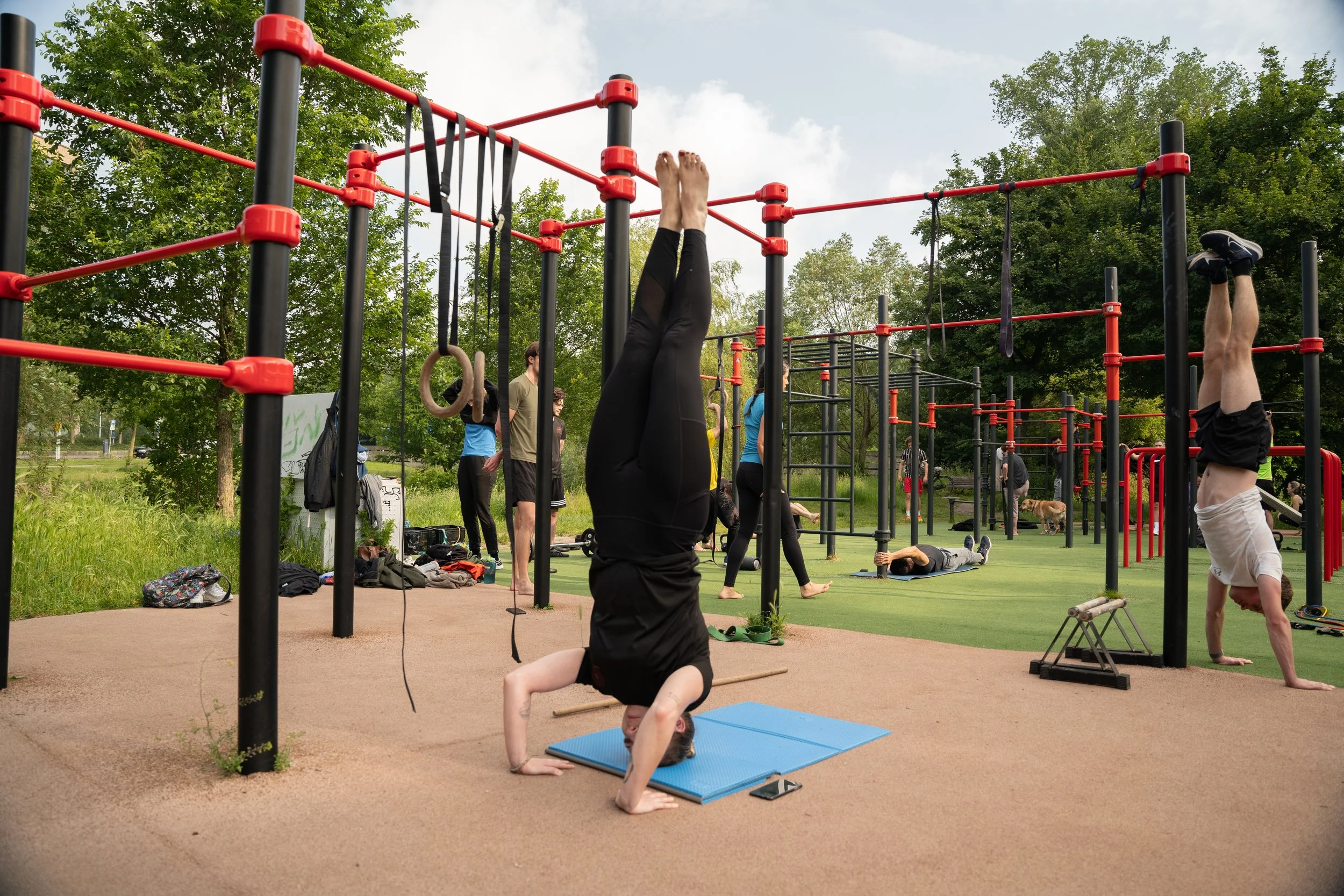
Group sessions at Famba run in Amsterdam West parks, with a coach leading a small group through a structured calisthenics session. You’re training alongside other people working toward similar goals, at a range of levels, all being coached in real time.
The energy is different. There’s something about training next to someone else pushing through their last rep that gets you through your own. Solo motivation runs out. Group motivation gets borrowed from the people around you on the days yours is low.
Accountability without pressure. Knowing a group is expecting you at a specific time, on a specific day, is a far stronger pull to actually show up than a vague personal intention to “train sometime this week.”
It’s more affordable. Coaching cost is split across the group, so you get expert-led, structured programming at a lower price point than fully individualized attention.
You still get real coaching. This isn’t a crowd doing whatever they want. A coach is watching form, correcting technique, and adjusting the session for the range of levels in the group.
What 1:1 Coaching Gets You
Personal training is one coach, entirely focused on you, for the full session.
Fully individualized programming. Your plan is built around your specific goals, your current level, any injuries or limitations, and your schedule. Nothing generic, nothing adjusted for a group average.
Faster technical correction. Every rep gets watched. Subtle form issues that would take weeks to notice and fix in a group setting get caught and corrected immediately.
Total flexibility on scheduling. Sessions build around your calendar rather than a fixed class time.
Ideal if you’re managing something specific. An old injury, a very particular goal (your first muscle-up by a set date, for example), or simply a preference for privacy while you build confidence, all of these are better served one-on-one.
The Honest Trade-offs
Group training’s biggest strength, the shared energy and lower cost, is also where it gives something up: the coach’s attention is split across everyone in the session, not locked onto your specific form the entire time.
1:1 coaching’s biggest strength, total individualized focus, comes at a higher cost per session and without the social, borrowed-motivation effect that keeps a lot of people consistent long term.
So Which Fits You?
If you’re motivated by community, want the most affordable path to expert coaching, and you don’t have a highly specific technical issue or injury to work around, group training is very likely your best starting point. Most people, honestly, do better long term with people around them than training entirely alone with just a coach for company. The accountability of a set class time, at a set place, with people who’ll notice if you don’t show up, is a genuinely underrated driver of consistency.
If you’re managing an injury, chasing a very specific and time-bound goal, or you know from experience that you focus better one-on-one, 1:1 coaching is worth the extra investment.
Plenty of people also start in a group to build a base, then add 1:1 sessions later for specific skill work. There’s no wrong order. And it’s worth saying plainly: you’re allowed to switch. Starting in a group and moving to 1:1 later once you’ve got a specific technical goal, or starting 1:1 to fix a specific issue before joining a group, are both completely normal paths. This isn’t a decision you’re locked into forever.
What We’d Tell a Friend Asking Us Directly
If someone we knew personally asked us this question with no context, no injury history, no specific short-notice deadline, our honest answer would be to start with group training. Not because it’s the cheaper option, though it is, but because the single biggest predictor of long-term results in calisthenics, or in any training method, is simply showing up consistently for months on end. Group training’s structure, a set time, a set place, other people who’ll notice if you’re missing, does more heavy lifting for consistency than almost any other single factor we can point to.
Start where most people build lasting consistency → /group-training-amsterdam-west
