
The Honest Verdict
If your goals genuinely require a squat rack and heavy barbells, keep the gym membership, or combine it with a bar at home for the days in between. If your training is mostly bodyweight, pull-focused, and something you want to do consistently without friction, a home pull-up bar saves real money within a season and gives back hours of commute and waiting time every single week. For a lot of people, especially anyone already doing calisthenics or bodyweight training, it’s not a supplement to the gym. It’s the better option outright.
Cut the commute. Train pull-ups at home.Let’s do actual math instead of vibes. A standard gym membership in Amsterdam runs somewhere between 25 and 50 euros a month, depending on the chain and the contract length. A home pull-up bar is a one-time purchase. So the real question isn’t “which is better” in the abstract, it’s how many months it takes for the bar to pay for itself, and what you’re actually getting for the ongoing cost of the gym.
The Cost Breakdown
Run a mid-range gym membership at roughly 35 euros a month and it adds up to 420 euros a year. A home pull-up bar, bought once, typically pays for itself inside two to three months and then costs nothing again, ever. No annual contract, no price increase notice in January, no fee for freezing your membership while you’re traveling.
The Time Cost Nobody Puts on the Invoice
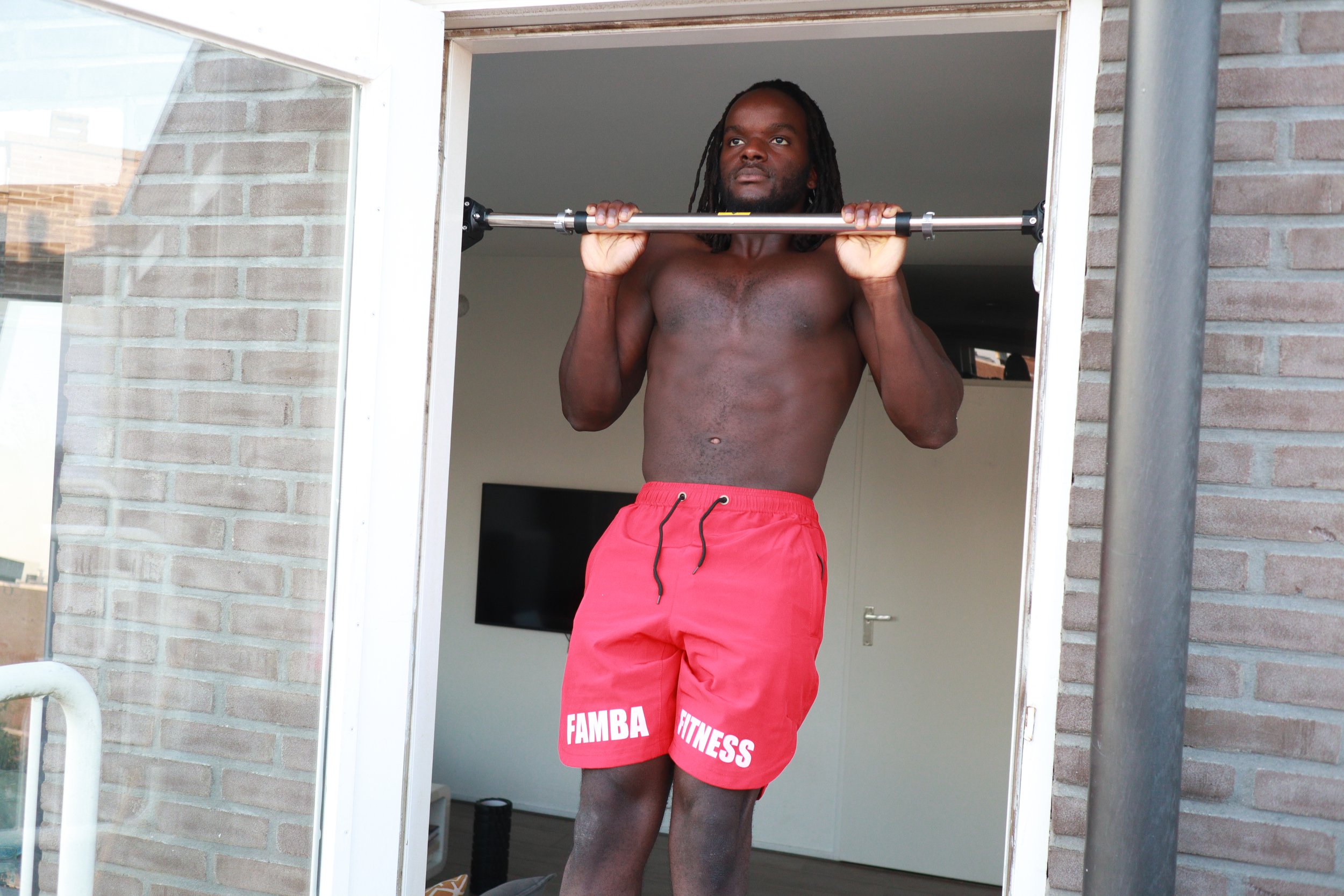
Membership price is only half the real cost. Add the commute (even a 15-minute cycle each way, in Amsterdam traffic and weather, adds up over a year), the time spent waiting for equipment during peak hours, and the mental friction of needing to “go somewhere” before you can train. A bar mounted in your own doorway removes all three. You walk past it. You use it. Ten minutes, done, no travel time attached to either side of the workout.
What You Actually Lose Without a Gym
To be fair: a gym gives you machines, heavy free weights, and other people training around you, which matters for motivation and for lifts that genuinely need external load, like heavy squats or bench press. A pull-up bar doesn’t replace a full barbell program. What it does replace is the specific, narrow reason a huge number of people keep paying for a membership they barely use: access to a pull-up bar and the space to do bodyweight pulling and core work.
The Membership-Guilt Problem
Dutch gyms, like everywhere, rely on a predictable number of people paying monthly and not showing up. If your actual use case is “pull-ups, dips, core work, maybe some conditioning,” you’re paying full price for a membership built around equipment you never touch. A home bar strips that down to exactly what you use, at a fraction of the ongoing cost.
A Realistic Hybrid Approach
For a lot of people, the actual answer isn’t strictly one or the other. Someone who trains at a gym twice a week for barbell work can still put a pull-up bar at home and use it on the three or four days they’re not making the trip, closing the gap between sessions instead of losing that pulling volume entirely. This is often the most practical setup: heavier compound lifts where a gym’s equipment genuinely earns its cost, and a home bar covering everything else, every day, without an extra commute attached to it.
Doing the Two-Year Math
Stretch the comparison out further and the gap gets harder to ignore. Two years of a 35 euro monthly membership comes to 840 euros, assuming you never miss a payment during a busy month, a holiday, or a stretch where motivation dips, which is exactly when memberships quietly keep charging you for a gym you’re not visiting. A home pull-up bar bought once carries none of that risk. It’s there on your worst week just as much as your best one, and the cost never moves regardless of how consistent you are.
The Honest Verdict
If your goals genuinely require a squat rack and heavy barbells, keep the gym membership, or combine it with a bar at home for the days in between. If your training is mostly bodyweight, pull-focused, and something you want to do consistently without friction, a home pull-up bar saves real money within a season and gives back hours of commute and waiting time every single week. For a lot of people, especially anyone already doing calisthenics or bodyweight training, it’s not a supplement to the gym. It’s the better option outright.
