
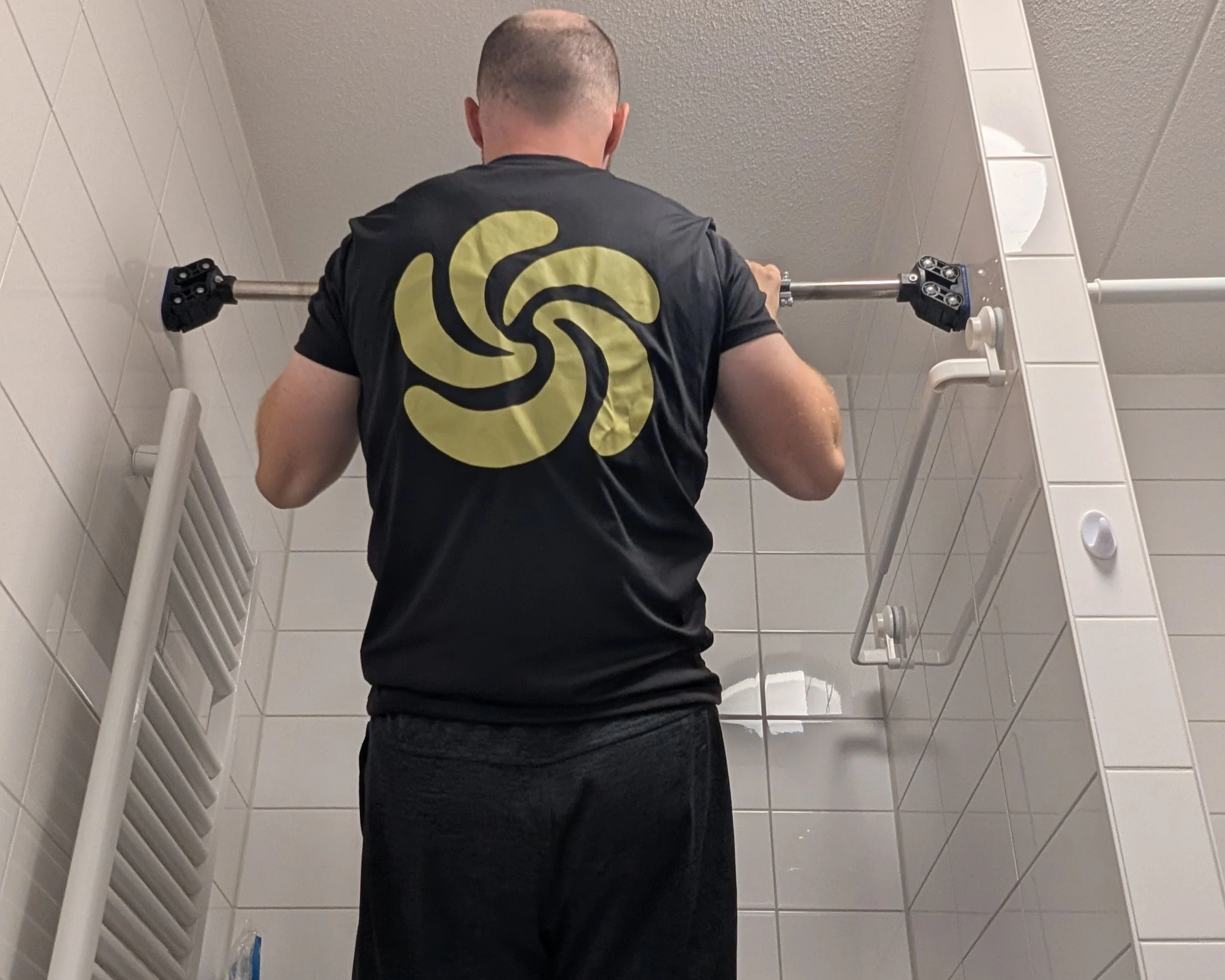
Most people overestimate what a single big workout does and underestimate what ten minutes a day does over a month. A home pull-up bar is the rare piece of equipment that actually rewards the second approach, because it’s always right there. No setup, no travel, no changing clothes. That accessibility is the whole advantage, and it’s worth building your training around it instead of around the idea of one “proper” session a week.
Grease the Groove
There’s an old strength-training principle called “grease the groove”: instead of training a movement to failure once, you practice it frequently, well under your max, every time you happen to pass the equipment. Applied to a home pull-up bar, that means every time you walk past it during the day, you do 2 to 4 reps, nowhere near failure, and walk away. Do that five or six times across a day and you’ve accumulated 15 to 20 quality reps without ever “working out” in the traditional sense.
Why This Works Better Than It Sounds
Frequent, sub-maximal practice builds the nervous system’s efficiency at a movement faster than occasional all-out sets do. It’s also just easier to sustain. A single scheduled 45-minute session competes with everything else in your day and loses more often than we’d like to admit. A 20-second hang on your way to make coffee competes with nothing.
Habit Stacking: Attach It to Something You Already Do
The easiest way to make this stick is to bolt it onto an existing habit rather than trying to build a new one from scratch.
Coffee brewing: a dead hang or a few reps while the machine runs
Waiting for the shower to heat up: a set of scapular pulls
Between work calls: 3 pull-ups, no more, no ego
Walking past the bar in a doorway you use daily: an automatic touchpoint, without even thinking about it
None of these need “motivation.” They need the bar to already be somewhere you walk past.
Tracking Without Overcomplicating It
You don’t need an app for this. A simple tally on a piece of paper or your phone’s notes app, one mark per set, is enough to see the accumulation. Most people are surprised, at the end of a week, to see they’ve done 80 to 100 total reps without a single dedicated “workout” on the calendar.
Where This Actually Leads
Four to six weeks of this kind of daily, low-friction volume builds grip endurance and pulling strength that a once-a-week gym session struggles to match, simply because of how much more total practice you’re getting. It’s not a replacement for structured training if you’re chasing a specific goal like a muscle-up. It is, however, the foundation that makes structured training easier, because your baseline strength and grip are already higher by the time you sit down to actually train hard.
What About the Days You Really Don’t Feel Like It
Some days the last thing you want is to hang from a bar. That’s fine, and it’s actually where this approach shows its real value: the standard is 2 to 4 easy reps, not a full workout, so “not feeling like it” is rarely a reason to skip entirely. Do the small version. A single dead hang on a low-motivation day still counts, still keeps the streak going, and still beats the alternative of skipping entirely and needing to restart the habit from zero next week.
Scaling Up Without Losing the Habit
As the weeks pass, it’s natural to want more structure than random touchpoints throughout the day. That’s fine too, and it’s actually the sign this is working: once the bar has become something you interact with automatically, layering in one or two proper sessions a week (the kind with real sets and rest periods) on top of the daily micro-reps gives you both consistency and progressive overload. The daily habit builds the foundation. The occasional structured session is what turns that foundation into visible strength gains.
Ten minutes, spread across a day, every day. It doesn’t feel like much in the moment. It adds up faster than almost anyone expects.
