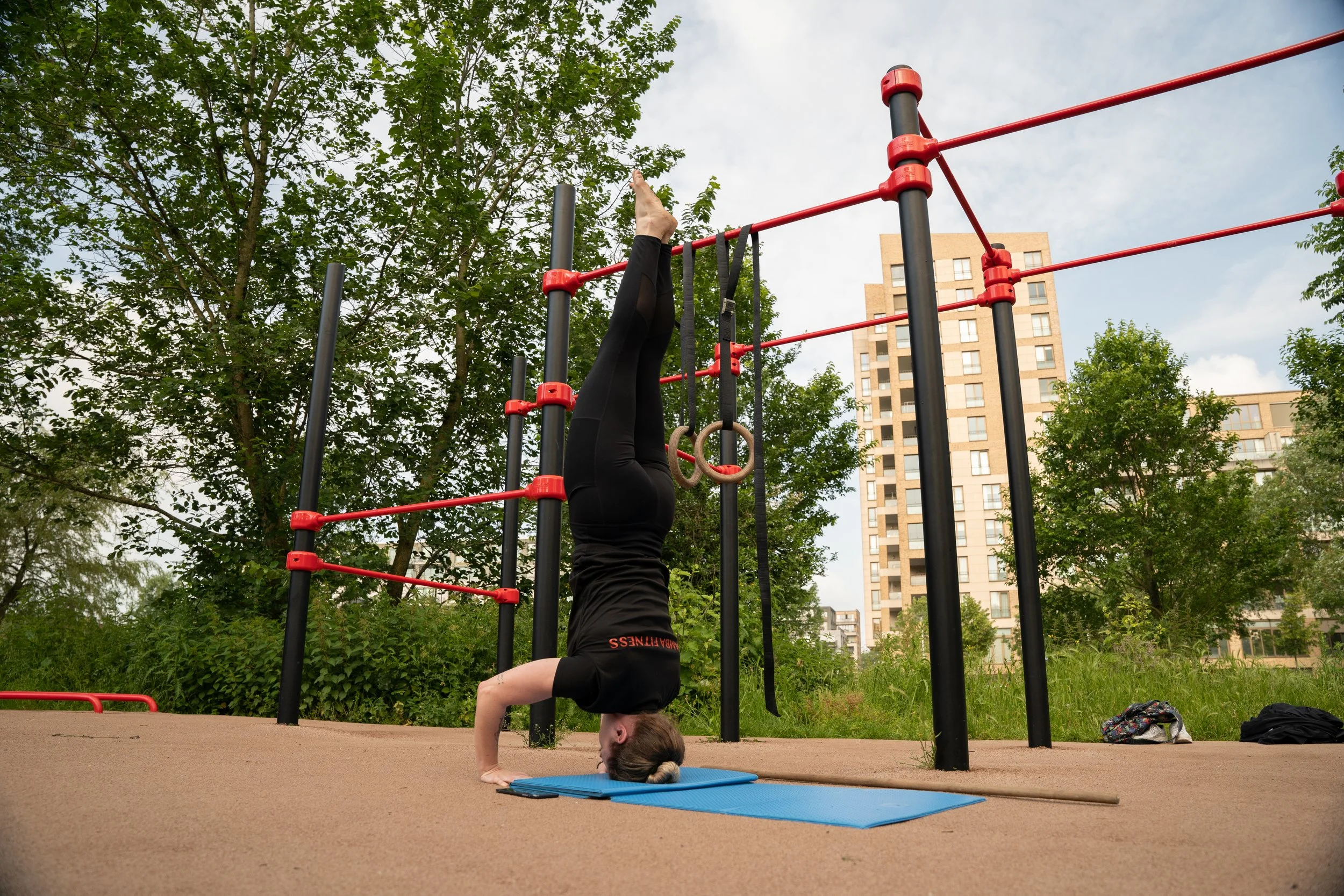
You’ve never done a pull-up. You’re not sure you can even do a full push-up. You look at calisthenics videos online and it feels like a completely different sport played by completely different bodies. Here’s the truth: everyone doing muscle-ups in Amsterdam parks started exactly where you are now. Here’s how to actually begin.
Forget What You’ve Seen Online
The calisthenics content that gets shared is the highlight reel, back levers, one-arm pull-ups, human flags. That’s not day one. That’s year three or four. If you measure yourself against that footage, you’ll quit before you start. Measure yourself against your own body, one week ago.
Step 1: Learn What You Can Already Do
Before you touch a bar, figure out your actual starting point. Most complete beginners overestimate what they can’t do and underestimate what they can. Test these:
Push-up: how many full push-ups can you do with good form, chest to the ground, before your form breaks down?
Squat: can you sit into a full bodyweight squat, thighs below parallel, without your heels lifting?
Plank: how long can you hold a plank with a straight line from shoulders to heels?
Hang: can you hang from a bar with straight arms for 20 seconds?
Whatever your numbers are, that’s your baseline. Not good or bad, just data.
Step 2: Start With Regressions, Not the Real Thing
If you can’t do a pull-up yet (and most true beginners can’t), you don’t skip pull training, you regress it. Try an inclined row using a low bar, leaning back with straight legs and pulling your chest to the bar. It trains the exact same muscles with less of your bodyweight to move.
Can’t do a full push-up? Do them from your knees, or with your hands elevated on a bench, and lower the incline as you get stronger.
Can’t hold a full plank? Hold it on your knees first, or break it into shorter sets.
This isn’t a lesser version of training. It’s the correct version of training for where your body is right now.
Step 3: Build a Simple, Repeatable Routine
Complexity kills consistency for beginners. Keep your first month embarrassingly simple:
Three sessions a week. Not seven. You need recovery time to actually adapt.
One push exercise, one pull exercise, one leg exercise, one core exercise per session. That’s it.
Three sets each, as many quality reps as you can manage. Stop a rep or two before your form breaks down, not after.
That’s a complete beginner program. It looks unimpressive on paper. It works.
Step 4: Train Outdoors, Even If It Feels Strange at First
If you’ve only ever trained indoors, or never trained at all, showing up to a park with a pull-up bar feels exposed the first few times. That feeling fades fast, usually within two or three sessions, once you realize nobody in an Amsterdam park is paying attention to your push-up form except you.
Parks around Amsterdam West give you everything a true beginner needs: a low bar for rows, open grass for core work, and space to move without waiting for equipment.
The Fastest Way to Skip the Guesswork
Here’s what actually slows beginners down: not knowing if they’re doing it right, not knowing what to progress to next, and quitting out of frustration rather than actually plateauing. A coach who can look at your specific body, your specific weaknesses, and build a plan around exactly that removes almost all of that guesswork.
If you’re truly starting from zero and want someone building your plan around your body instead of a generic beginner template, that’s exactly what 1:1 training is built for.