
How to Choose the Right Pull-Up Bar for Your Home
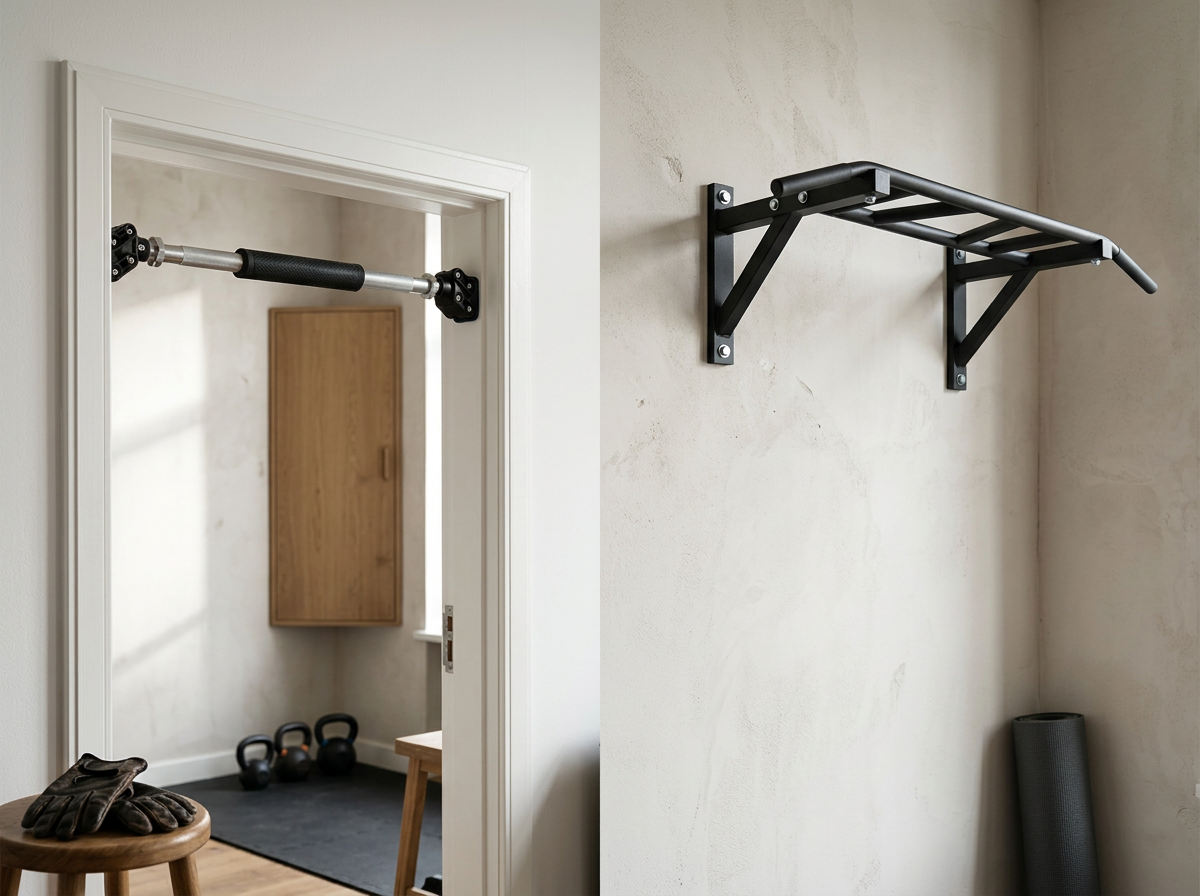
So which is better: a doorway pull-up bar or a wall-mounted pull-up bar?
If you're looking for a pull-up bar for your home, you might be surprised by how many different options are available. Doorway pull-up bars, wall-mounted pull-up bars, ceiling-mounted bars, free-standing stations and removable bars all have their advantages, but the best option for you depends on your home, your training goals and how you actually plan to use it.
The good news is that you don't need to turn your home into a gym to start training calisthenics. A simple pull-up bar can give you access to one of the most useful tools for developing upper-body strength, grip strength and body control. The key is choosing one that fits your space and your training.
What should you look for in a home pull-up bar?
The first thing to consider is where you want to put the pull-up bar. This sounds obvious, but it's one of the most important decisions because different types of pull-up bars require different setups.
A wall-mounted pull-up bar, for example, needs to be permanently attached to a suitable wall. This can provide a very solid training setup, but it also means drilling into your wall and having a dedicated space for the equipment.
A doorway pull-up bar is a different approach. Instead of permanently mounting the equipment, it uses a compatible door frame as its support structure. This can make it a convenient option if you live in a rental property, have limited space or simply don't want a permanent piece of gym equipment taking up room in your home.
The important thing is to think about your environment first rather than choosing a pull-up bar purely because it looks good online.
How much space do you need?
One of the biggest advantages of a doorway pull-up bar is that it requires very little dedicated space.
Your doorway is already there, so you don't need to find an empty section of wall or create a separate training area. Once the bar is installed correctly, you can simply use the space around the doorway to train.
That can be particularly useful if you're living in an apartment or have a smaller home.
However, you still need to make sure you have enough clearance around the bar to perform your intended exercises comfortably. Think about the height of your doorway, the space underneath the bar and whether you'll be able to hang without your feet constantly touching the floor.
A pull-up bar should make training easier, not force you to work around your furniture.
Doorway pull-up bar vs wall-mounted pull-up bar
So which is better: a doorway pull-up bar or a wall-mounted pull-up bar?
There isn't one universal answer.
A wall-mounted pull-up bar can be an excellent choice if you have a suitable wall, you're happy to drill and you want a permanent training station. It can also give you more freedom for certain movements because you aren't restricted by the dimensions of a doorway.
A doorway pull-up bar, on the other hand, prioritises convenience and accessibility. You can use an existing doorway rather than dedicating part of your home to a permanent installation.
For many people, that's enough.
The most important thing is choosing the setup that you're actually going to use consistently.
Because having a fantastic pull-up bar mounted on the wall doesn't help much if you never use it.
What if you can't do a pull-up yet?
This is where I think a lot of people make the wrong assumption.
They see a pull-up bar and think it's only useful once they can already do a pull-up.
It's actually the opposite.
If you're working towards your first pull-up, a bar gives you the opportunity to practise all the movements that eventually build towards it. You can start with dead hangs to develop your grip and become comfortable supporting your bodyweight. You can work on scapular pull-ups to develop shoulder control, practise isometric holds and use eccentric pull-ups to build the strength required to control your body through the movement.
You don't need to jump straight into full pull-ups.
In calisthenics, progress often comes from breaking a difficult skill down into manageable pieces and gradually building your strength and control.
Having a bar available at home gives you a convenient place to practise those pieces.
Why having a pull-up bar at home can help with consistency
One of the biggest benefits of home training isn't necessarily the equipment itself. It's the reduction in friction.
Think about what happens when you need to go to the gym. You have to get ready, travel there, find the equipment you need, complete your workout and then travel home.
There's nothing wrong with that, but every additional step creates another opportunity for you to decide that you'll do it tomorrow.
With a pull-up bar at home, the barrier is much lower. You can walk past the bar and do a short set of hangs. You can practise a few scapular pull-ups between tasks. You can dedicate 15 minutes to working on your pull-up progression without needing to leave the house.
Those small sessions aren't necessarily a replacement for structured training, but they can make movement much easier to integrate into your everyday life.
The Famba Home Pull-Up Bar
This is one of the reasons we created the Famba Home Pull-Up Bar.
The idea was to create a simple way for people to bring one of the fundamental pieces of calisthenics equipment into their home without needing to drill into their walls or create a dedicated gym space.
The Famba Home Pull-Up Bar is designed for compatible door frames between 72 and 92 cm wide. It uses an adjustable twist-to-expand system with locking clamps and non-slip contact points to help secure the bar in place.
As with any doorway pull-up bar, it's important to check that your specific doorway meets the product requirements and to follow the installation and safety instructions before using it.
The goal isn't to give you more equipment for the sake of having more equipment.
It's to make one of the most useful movements in calisthenics easier to practise.
So, which pull-up bar is right for you?
The right home pull-up bar is ultimately the one that fits your space, suits your training and makes it easier for you to train consistently.
If you have a suitable wall and want a permanent setup, a wall-mounted bar may make sense. If you want something that takes up minimal space and doesn't require permanent installation, a doorway pull-up bar could be a better option.
And if you're a beginner, don't worry about whether you're strong enough to use one. You can use a pull-up bar from day one and gradually work through the progressions that take you towards your first pull-up.
The equipment is only one part of the equation.
The bigger question is whether you've created an environment that makes it easier for you to move, practise and get stronger.
Because sometimes the best training equipment isn't the most complicated piece of equipment.
It's the one that's right there when you're ready to use it.
