
How to Get Your First Pull-Up at Home
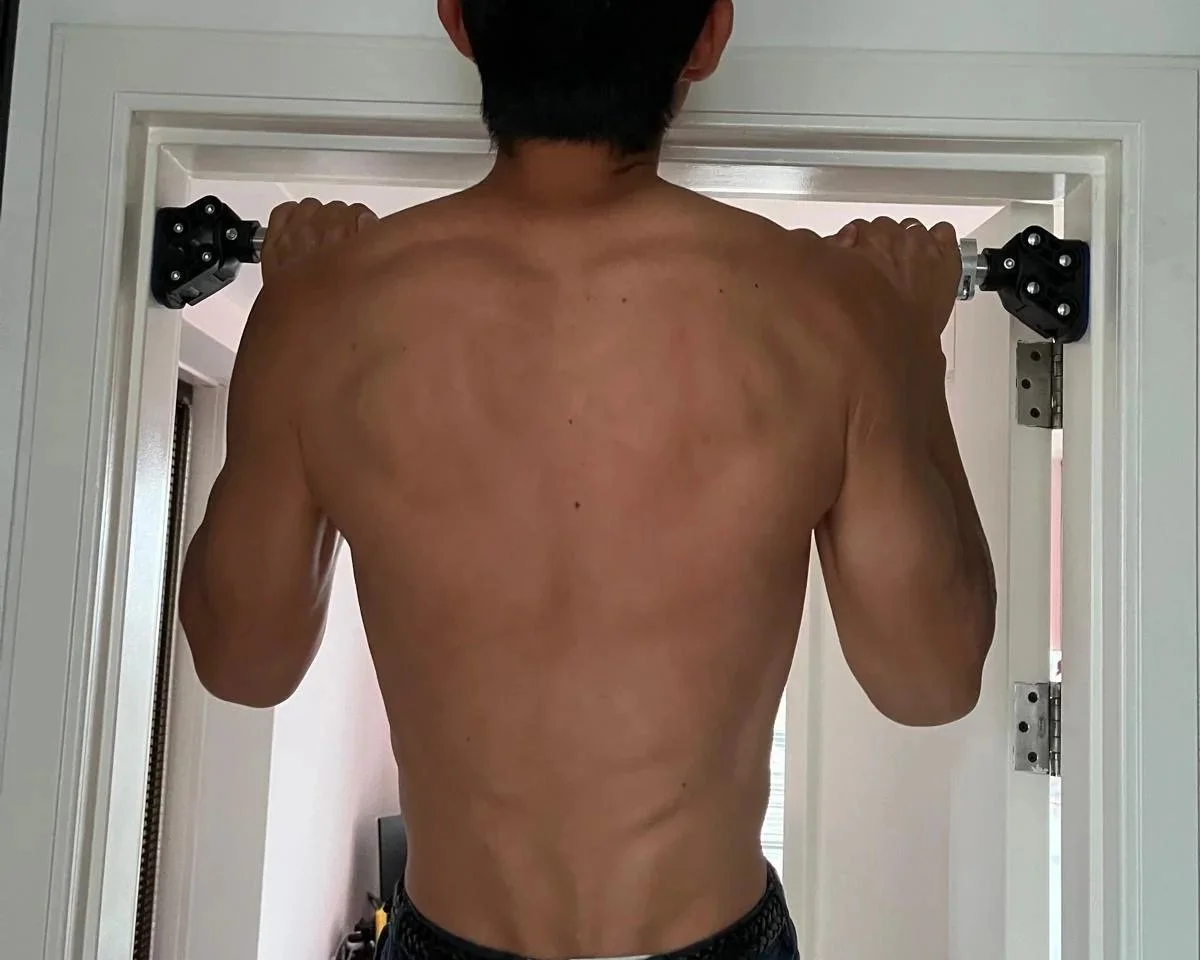
Getting your first pull-up is one of those calisthenics goals that can seem much further away than it actually is. You see someone casually pull themselves over a bar and it looks simple, but when you try it yourself, your body doesn't seem to agree.
You pull, nothing happens. You try again, and maybe you get a little higher. Then you start wondering whether you're simply not strong enough to do a pull-up.
The good news is that you don't need to already be strong enough to do a pull-up to start training for one. Your first pull-up is something you can build towards, and you can do a lot of that training at home with a good pull-up bar and the right progressions.
The important thing is to stop thinking of the pull-up as one exercise that you either can or can't do. Instead, think of it as a skill made up of several different physical qualities that you can train individually.
Start by Building Your Grip
Before worrying about pulling yourself over the bar, you need to become comfortable simply hanging from it.
Your grip is the connection between you and the bar. If your hands and forearms aren't strong enough to support your bodyweight, you're going to struggle to get very far with your pull-up, regardless of how strong the rest of your body is.
A simple dead hang is a great place to start. Grab the bar, let your body hang underneath it and focus on maintaining a controlled position.
You don't need to hang for minutes at a time. Start with a duration that you can manage with good control and gradually build from there.
As your grip becomes stronger, hanging from the bar starts to feel less like an exercise in survival and more like a normal position for your body.
That matters because you want to remove grip strength as a limiting factor as you progress towards your first pull-up.
Learn to Control Your Shoulder Blades
Once you're comfortable hanging, the next thing to develop is your scapular control.
Scapular pull-ups are a simple but important progression. Instead of bending your elbows and trying to pull your entire body upwards, you focus on controlling your shoulder blades while keeping your arms relatively straight.
This might not look as impressive as a full pull-up, but that's not the point.
You're learning how to initiate the pulling movement and control your shoulders while supporting your bodyweight. Developing this foundation can make your eventual pull-up much more efficient and give you greater awareness of what your shoulders are doing during the movement.
It's also one of the reasons I wouldn't recommend simply trying full pull-ups over and over again if you're not ready for them yet.
Sometimes the fastest way to get somewhere is to stop trying to do the final movement and build the pieces that make the movement possible.
Start Practising Your Pulling Strength
After building some grip and scapular control, you can start working more directly on your pulling strength.
One useful progression is the horizontal row. With a suitable setup, you can position your body underneath a bar or, ideally, a set of rings and pull your chest towards your hands.
The advantage of horizontal pulling is that you have more control over how much of your bodyweight you're moving. You can adjust your body position to make the exercise easier or harder as your strength improves.
You're also developing the muscles involved in pulling, including your upper back, lats and arms.
This gives you a stronger foundation before you start asking your body to pull its entire weight vertically.
Don't Ignore Isometric Holds
Another useful step towards your first pull-up is the isometric hold.
Instead of performing repetitions, you simply hold yourself in a particular position.
For example, you can use a step or another method of assistance to get your chin over the bar and then hold yourself there. Initially, you might keep your feet on the ground to reduce the amount of weight you're supporting. As you become stronger, you can gradually remove that assistance.
You can also practise holding yourself at different points throughout the pull-up.
This teaches your body to produce force while maintaining a specific position rather than only focusing on moving from the bottom to the top.
And that's useful because a pull-up isn't just about getting your chin over the bar. You need to be able to control your body throughout the entire movement.
Use Eccentric Pull-Ups to Build Strength
Eccentric pull-ups are another important progression for anyone working towards their first pull-up.
The idea is simple: instead of trying to pull yourself up, you start at the top and slowly lower yourself down.
You can use a step or another form of assistance to get into the top position. From there, remove as much assistance as possible and control your descent.
This is often a much more accessible way to start experiencing the full pull-up movement because you're focusing on the lowering phase rather than trying to generate enough force to pull yourself upwards.
The goal is to make the descent controlled rather than simply dropping from the top.
Over time, you'll hopefully find that you can control yourself for longer and longer before reaching the bottom.
You Don't Need to Test Your Pull-Up Every Day
This is something worth remembering.
If your goal is to get your first pull-up, it can be tempting to jump onto the bar every day and see if you've suddenly become strong enough.
But constantly testing the skill isn't the same as training it.
You need to give your body a reason to adapt. That means spending your training time developing the underlying qualities that you need for the pull-up and gradually increasing the challenge.
There will be days when you feel stronger and days when you don't. That's normal.
What matters is that you're building a consistent practice rather than judging your progress based on whether you can perform one repetition today.
Why a Pull-Up Bar at Home Can Help
One of the biggest advantages of having a pull-up bar at home is simply accessibility.
You don't need to travel to the gym every time you want to practise hanging, scapular pull-ups or one of your progressions. The equipment is already there.
That doesn't mean you need to train all day. In fact, short and focused sessions can be incredibly useful when you're working on a skill.
You might have ten minutes available before work, during a break or in the evening. Instead of thinking, "I don't have enough time for a workout," you can simply practise one or two movements.
Over weeks and months, those small opportunities can add up.
This is one of the reasons we created the Famba Home Pull-Up Bar. The goal isn't to turn your doorway into a full gym. It's to give you a simple and accessible place to work on one of the foundations of calisthenics.
If your doorway is compatible, the Famba Home Pull-Up Bar can be installed without drilling and is designed for door frames between 72 and 92 cm wide. It uses an adjustable twist-to-expand system with locking clamps and non-slip contact points.
As always, check your specific doorway against the product requirements and follow the installation and safety instructions before using the bar.
Your First Pull-Up Is a Process
Your first pull-up probably won't happen because you suddenly wake up one morning with dramatically more strength.
It will happen because you've gradually built the pieces required to perform it.
Your grip becomes stronger. Your shoulders become more controlled. Your back becomes stronger. You learn how to hold your body in different positions. You become comfortable controlling your weight through the movement.
Then, at some point, all of those pieces start to come together.
You grab the bar, pull, and suddenly your body moves in a way it couldn't before.
That's the exciting part of calisthenics.
You aren't just chasing a number. You're teaching your body to do something it couldn't previously do.
So if your first pull-up still feels a long way away, don't worry about the distance.
Focus on the next progression.
Hang. Control. Pull. Lower. Repeat.
That's how you start building your way towards your first pull-up.
